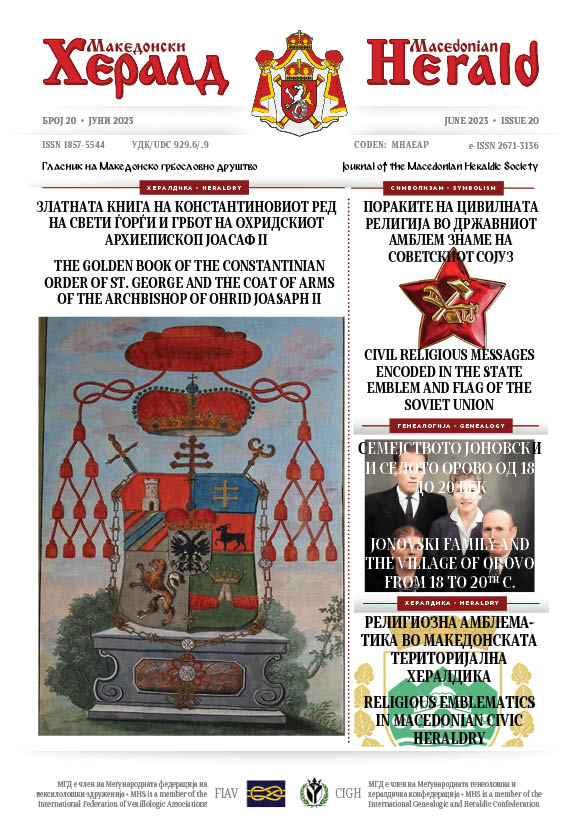
Civil Religious Messages Encoded in the State Emblem and Flag of the Soviet Union
DOI:
https://doi.org/10.47763/mher2320003pKeywords:
Soviet Union, state emblem, socialist heraldry, communist symbols, hammer and sickle, civil religionAbstract
West’s definition provides a basis for the examination of state symbols as part of a broader framework of political culture and societal norms. Modern states equip themselves with a set of symbols that, typically, are then incorporated into a civil religious culture which reflects the values of the state. Inherent to these symbols are messages transmitted from the state to the citizenry that are intended to remind the citizen of their obligations to their country. This article will discuss one such symbol set – that of the Union of Soviet Socialist Republics. The intent is to examine visual state symbols, consider the meaning attributed to these symbols, and demonstrate how the symbols were used to convey civil religious messages to citizens of the Soviet Union. While the USSR is no longer a state, an examination of its symbols is useful to the study of symbols in civil religion for several reasons. First, it stands as a case study of a state with a well-developed propaganda system where symbols were heavily used throughout the society. Next the USSR stands as an example where, despite sustained efforts to forge a shared identity through civil religious practice, the state failed to preserve the union allowing its fifteen republics to go their separate ways. Finally, the case of the Soviet Union is particularly interesting because its symbols continue to have relevance decades after the breakup of the USSR.
Downloads
References
Bolotina, S. 1983. «Kak sozdavalsja nash gerb. Nauka i zhizn', # 11 (nojabr'): 20-24.
Evgen'eva, A. P. 1981. «Simvolika.» In Slovar' russkogo jazyka, 2-e izd., 4:49. Moskva: Izdatel'stvo «Russkij jazyk».
Ivanchenko, Aleksandr Vladimirovich. 1987. Sojuz serpa i molota: Gosudarstvennye simvoly RSFSR. Moskva: Sovetskaja Rossija.
Izvestija. 1918. «Znachek krasnoarmejca.» 19 aprelja 1918, # 77, 5.
Karamanchev, Valentin. 1978. Proletarskaja simvolika. Moskva: Progress.
Karpenko, V. A. 1986. «Nashi slavnye simvoly». Vospitanie shkol'nikov, # 4: 59-63.
Kiblickij, Jozef. 1997. «Nemnogo o cvete, o krasnom cvete...» V Krasnyj cvet v russkom iskusstve, red. Evgenija Petrova, 6-7. Sankt-Peterburg: Gosudarstvennij Russkij muzej.
Kiselev, G. F., i V. A. Ljubisheva. 1966. «V. I. Lenin i sozdanie gosudarstvennoj pechati i gerba RSFSR.» Istorija SSSR, # 5 (sentjabr'-oktjabr'): 21-26.
Kiselev, Georgij Fedorovich, i Nikolaj Nikolaevich Speransov. 1968. Jemblemy mira i truda: Gosudarstvennye gerby i flagi Sovetskogo Sojuza i sojuznyh respublik. Moskva: Izdatel'stvo politicheskoj literatury.
Lapshin, Vladimir Pavlovich. 1983. Hudozhestvennaja zhizn' Moskvy i Petrograda v 1917 godu. Moskva: Sovetskij hudozhnik.
Losev, Aleksej Fedorovich. 1976. Problema simvola i realisticheskoe iskusstvo. Moskva: Iskusstvo.
Maksjashev, P. F. 1965. «Kogda vpervye v Rossii bylo podnjato krasnoe znamja.» Voprosy istorii, # 3 (mart): 206-7.
Mamaev, Konstantin Konstantinovich. 1972. Flagi rasskazyvajut. Leningrad: Avrora.
Marks, Karl i Fridrih Jengel's. 1980. Manifest Kommunisticheskoj partii. Moskva: Izdatel'stvo politicheskoj literatury.
Mysova, L. 1986. «Ispol'zovanie gosudarstvennoj simvoliki v vospitatel'noj rabote.» Vospitanie shkol'nikov, # 6: 13-16.
Poceluev, Vladimir A. 1987. Gerby Sojuza SSR: Iz istorii razrabotki. Moskva: Izdatel'stvo politicheskoj literatury.
Pravda. 1918. «Znachek krasnogvardejcev», 19 aprelja 1918, # 75, 4.
Prohorov, A. M, red. 1970. Bol'shaja sovetskaja jenciklopedija. Izd. 3-e . V 30 tomah. Moskva: zdatel'stvo «Sovetskaja Jenciklopedija».
Roshhin, Lev Vasil'evich. 1989. Nashi voinskie simvoly. Moskva: Izdatel'stvo DOSAAF SSSR.
Signev, A. 1964. «Kak sozdavalsja gosudarstvennyj flag nashej rodiny.» Voprosy istorii, # 11 (nojabr'): 211-15.
Soboleva, Nadezhda Aleksandrovna. 2006. «Iz istorii sovetskoj politicheskoj simvoliki.» Otechestvennaja istorija, # 2 (mart-aprel'): 89-109.
Sovetskij Sojuz. Central'noe Statisticheskoe Upravlenie. 1984. Chislennost' i sostav naselenija SSSR: po dannym Vsesojuznoj perepisi naselenija 1979 goda. Moskva: Finansy i statistika.
Sovetskij Sojuz. 1979. Konstitucija (Osnovnoj Zakon) Sojuza Sovetskih Socialisticheskih Respublik: Prinjata na vneocherednoj sed'moj sessii Verhovnogo Soveta SSSR devjatogo sozyva 7 oktjabrja 1977 g. Moskva: Izdatel'stvo «Juridicheskaja literatura.»
Sokolov, Vladislav Aleksandrovich. 2001. Flagi Rossijskoj Imperii i SSSR v dokumentah. Moskva: MGIU.
Haritonov, O. V. 1960. Illjustrirovannoe opisanie obmundirovanija i znakov razlichija Krasnoj i Sovetskoj Armii (1918–1945 gg.). Leningrad: Artillerijskij istoricheskij muzej.
Chernikov, Nikolaj Dmitrievich. 1987. Nasha krasnaja zvezda. Moskva: Detskaja literatura.
Calhoun, Gloria. 2014. “Saints Into Soviets: Russian Orthodox Symbolism and Soviet Political Posters.” Master’s thesis, Atlanta, GA: Georgia State University. https://scholarworks.gsu.edu/history_theses/85.
Cartledge, John. 2022. “Though Cowards Flinch: The Story of the Red Flag as a Symbol of Rebellion.” In Proceedings of the 26th International Congress of Vexillology (Sydney, Australia 31 August - 4 September 2015), 116-27. https://fiav.org/wp-content/uploads/2022/06/26-07-Cartledge.pdf.
Chadaga, Julia Bekman. 2007. “Light in Captivity: Spectacular Glass and Soviet Power in the 1920s and 1930s.” Slavic Review 66 (1): 82-105. https://doi.org/10.2307/20060148.
Chernyak, A. S. 1967. “Kremlin Ruby Stars Are 30 Years Old (Development of Ruby Glass).” Glass and Ceramics 24 (11): 650-51. https://doi.org/10.1007/BF00677577.
Coleman, John A. 1970. “Civil Religion.” Sociological Analysis 31 (2): 67-77. https://doi.org/10.2307/3710057.
Crampton, William G. 1990. Flags of the World: A Pictorial History. New York: Dorset Press.
Figes, Orlando, and B. I. Kolonitskii. 1999. Interpreting the Russian Revolution: The Language and Symbols of 1917. New Haven: Yale University Press.
Ivanov, Konstantin A. 1966. “Soviet Russian Flags.” Translated by Whitney Smith. The Flag Bulletin 6 (1–2): 42-51.
Jilek, Wolfgang G. 2001. “Nazi and Communist Flags: Semiotic Aspects and Psychophysiological Dynamics of Totalitarian Symbols.” The Flag Bulletin No. 197, v. 40 (1): 1-40.
Kharitonov, O.V. 1993. Soviet Military Uniform and Insignia, 1918-1958. St. Petersburg: Alga-Fund.
Kurkovsky, Diana. 2007. “Monumentalizing Wheat: Soviet Dreams of Abundance.” Gastronomica 7 (1): 15-17. https://doi.org/10.1525/gfc.2007.7.1.15.
Lane, Christel. 1981. The Rites of Rulers: Ritual in Industrial Society - the Soviet Case. Cambridge [Eng.]: Cambridge University Press.
Marx, Karl, and Friedrich Engels. 1948. Manifesto of the Communist Party. New York: International Publishers.
Prokhorov, Aleksandr Mikhailovich, ed. 1973. Great Soviet Encyclopedia. 31 vols. New York: Macmillan. English translation of Прохоров, А. М, ред. 1970. Большая советская энциклопедия. Изд. 3-е . В 30 томах. Москва: здательство «Советская Энциклопедия».
Pronin, Alexander, and Barbara Pronin. 1975. Russian Folk Arts. South Brunswick, NJ: A. S. Barnes and Company.
Rousseau, Jean-Jacques. 1978. “On Civil Religion.” In On the Social Contract with Geneva Manuscript and Political Economy, ed. by Roger D. Masters, translated by Judith R. Masters, 124-33. New York: St. Martin’s Press.
Shanskii, Nikolai Maksimovich. 1968. Russian Word Formation. Oxford: Pergamon Press.
Smith, Whitney. 1972. “Soviet State Symbolism.” In Soviet State Symbolism: Flags and Arms of the USSR and Its Constituent Parts, 1917-1971, 26–42. The Flag Bulletin, v. 11 #1. Winchester, MA: Flag Research Center.
Smith, Whitney. 1975. Flags Through the Ages and Across the World. New York: McGraw-Hill.
Soboleva, Nadezhda Aleksandrovna. 2008. “From the History of Soviet Political Symbolism.” Russian Studies in History 47 (2): 59-91. https://doi.org/10.2753/RSH1061-1983470204.
Soviet State Symbolism: Flags and Arms of the USSR and Its Constituent Parts, 1917-1971 (1972). Winchester, Mass.: Flag Research Center, Winter Mass.: Flag Research Center, Winter 1972
Soviet Union. 1941. The Soviet Socialist Constitution. Moscow: Russia To-day Society.
Thomas, Dean. 2014. “Flags and Emblems of the Democratic People’s Republic of Korea: Vexillidolatry in Its Purest Form.” Raven: A Journal of Vexillology 21: 95-115. https://doi.org/10.5840/raven2014215
West, Ellis M. 1980. “A Proposed Neutral Definition of Civil Religion.” Journal of Church and State 22 (1): 23-40. https://doi.org/10.1093/jcs/22.1.23
Znamensky, Pierre, and Guy Gallice. 2010. Sous les plis du drapeau rouge. Rodez: Rouergue.
Znamierowski, Alfred. 1999. The World Encyclopedia of Flags: The Definitive Guide to International Flags, Banners, Standards and Ensigns. London: Lorenz.
Downloads
Published
How to Cite
Issue
Section
Categories
License
Copyright (c) 2023 Anne Platoff

This work is licensed under a Creative Commons Attribution-NonCommercial-ShareAlike 4.0 International License.
Copyright of the articles remains with the author.
By submitting the article the author allows Macedonian herald (Macedonian Heraldic Society) to publish it in the printed version, and on its website and on Open Journal System, and other social media under
Attribution-NonCommercial-ShareAlike 4.0 International (CC BY-NC-SA 4.0) CC BY-NC-SA 4.0