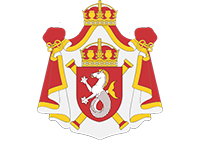
The Stierkopf Motif in the Medieval Heraldry of Mecklenburg and Moldavia
DOI:
https://doi.org/10.47763/mher.2026.6658Keywords:
Хералдика на Мекленбург, Војвода од Верле, Кнежевство Молдавија, биковска глава, Молдавски бизони, Династички ознакиAbstract
During the later Middle Ages, European territories developed heraldic emblems that functioned not only as dynastic insignia but also increasingly as markers of territorial identity. This study examines parallel developments in heraldic imagery of the thirteenth and fourteenth centuries, focusing on the Duchy of Mecklenburg and the Moldavian Principality, where analogous visual formulas were employed to represent authority, land, and rulership.
The process by which territories acquired their own insignia followed a broadly comparable pattern across much of Europe—from the Baltic coast to the Carpathians—and unfolded in parallel with the consolidation of local principalities, duchies, and voivodeships. In this context, the coat of arms evolved beyond a purely dynastic marker to become a symbol of political agency.
Mecklenburg, formed on the former lands of the Obodrite confederation and the Moldavian Principality, which emerged along the frontier between the Latin and Orthodox worlds, developed according to similar internal logics. Both required a recognizable sign of legitimacy. It is therefore unsurprising that their coats of arms, created independently of one another, display a striking iconographic affinity: the bull’s or aurochs’ head – Stierkopf as a symbol of strength, courage, and authority.
Downloads
References
Ahnentafel des Hauses Mecklenburg. N.d. eMecklenburg
https://www.emecklenburg.de/Niklot/i0006.htm
Bătrîna, Lia, and Adrian Bătrîna (2012). Biserica „Sfântul Nicolae” din Rădăuți. Cercetări arheologice și interpretări istorice asupra începuturilor Țării Moldovei. Bibliotheca Memoriae Antiquitatis, vol. 29. Piatra Neamț: Editura Constantin Matasă.
Bielski, Marcin (1597). Kronika polska, Marcina Bielskiego. Nowo przez Ioach.[ima Bielskiego syna iego wydana.] Krakow
Bogdan, D. P. (Ed.). (1941). Pomelnicul Mănăstirii Bistrița [Register of the Bistrița Monastery]. București: Fundația Regele Carol I.
Boll, Ernst (1855). Geschichte Mecklenburgs mit besonderer Berücksichtigung der Kulturgeschichte. Vol. 1. Neubrandenburg.
Bei der Wieden, Helge (1978). “Ein Landeswappen für Mecklenburg(-Vorpommern).” Baltische Studien 64. Göttingen: Verlag Christoph von der Ropp.
Cârciumaru, Radu (2019). Simion Florea Marian and the Legends about the Beginnings of Moldavia, Valahia University of Targoviste.
Cernovodeanu, Dan (1977). Ştiinţa şi arta heraldică în România [The Science and Art of Heraldry in Romania]. Editura Științifică și Enciclopedică, Bucureşti, 566 pp.
Chisholm, Hugh, ed. (1911). Radautz. Encyclopædia Britannica. Vol. 22 (11th ed.). Cambridge University Press.
Długosz, Jan (1885). Insignia seu Clenodia Regis et Regni Poloniae..., edited by Celichowski, S. Poznań.
Długosz, Jan (1887). Joannis Dlugossii Senioris Canonici Cracoviensis Opera omnia. Vol. 1, Vita S. Stanislai: vita B. Kunegundis: vitae episcoporum poloniae: vita Sbignei de Oleśnica cardinalis: Clenodia. Banderia Prutenorum: Epistolae. Krakow.
Dogaru Maria (1994). Din heraldica României, Ed. Jif, Brașov.
Eliade, Mircea (1972). Zalmoxis, the Vanishing God: Comparative Studies in the Religions and Folklore of Dacia and Eastern Europe, University of Chicago Press.
Feist, Peter (1995). Der Burgwall am Kap Arkona (= Der historische Ort, H. 1: Mecklenburg-Vorpommern, Rügen). K und K Kunsthandel / Kai Homilius Verlag, Berlin.
Gauthier, Adolphe (1878). Les armoiries et les couleurs de la Confédération et des cantons suisses. Genève: H. Georg, p. 36-50.
Gorovei, Ștefan S (1972). “Les armoiries de la Moldavie et de ses princes règnants (XIVe–XVIe siècles).” In Recueil du 11ᵉ congrès International des Sciences Généalogique et Heraldique, p. 266.
Ignat, Mircea (2006). Necropolele tumulare din zona Rădăuți în cadrul lumii traco-getice (sec. VII–V a. Ch.). Suceava: Editura Cetatea de Scaun.
Ivanov, Rumen (1990). “Lixa Legionis V Macedonicae aus Oescus.” Zeitschrift für Papyrologie und Epigraphik 80 (1990): 131–136.
Jitaru, Grigore (1997). Blazoane domnești în Țara Românească și Moldova: sec. XII–XV [Princely Blazons in Wallachia and Moldavia: 12th–15th Centuries]. Chișinău: Editura Uniunii Scriitorilor.
Lisch, Georg Christian Friedrich (1842). “Über die Vormundschaft und den Regierungs-Antritt des Fürsten Albrecht II. (I.) des Großen von Mecklenburg.” Jahrbücher des Vereins für Mecklenburgische Geschichte und Altertumskunde 7: 1–51.
Mănescu, Jean‑Nicolas (1973). “Stemele lui Dimitrie Cantemir și locul lor în heraldica Țărilor Române.” Revista Arhivelor, no. 3, 1973.
Mykhailyna, Lyubomyr, Oleh Odnorozhenko, and Serhiy Pivovarov (2013). „The Seal of Voivode Bohdan: Sphragistic Finds from the XIV Century Settlement in the Village of Zelena Lipa and Their Significance for the Study of the Formation of the State Heraldry of the Moldavian Principality“. Sphragistic Yearbook, no. IV, 2013, pp. 122–124.
Mitteilungen der Antiquarischen Gesellschaft in Zürich (1856). Bd. 9. Zürich.
Münch, Ernst (1995). Herrschaftsbildung und Staatswerdung in Mecklenburg und Vorpommern im 13. und 14. Jahrhundert. In: Wolf Karge (Hrsg.): Ein Jahrtausend Mecklenburg und Vorpommern. Biographie einer norddeutschen Region in Einzeldarstellungen. Hinstorff, Rostock, S. 43–49.
Odnorozhenko, Oleh (2011). Ukrainian (Ruthenian) Elite of the Medieval and Early Modern Period: Structure and Power. Kyiv, , pp. 81–82. (in Ukrainian).
Paprocki, Bartosz (1858). Herby rycerstwa polskiego przez Bartosza Paprockiego zebrane i wydane r. p. 1584; wydanie Kazimierza Józefa Turowskiego. Kraków, s. 903.
Peter, Bernhard (2020) “Historische heraldische Exlibris.” Welt der Wappen. Accessed January 27, 2026. http://www.welt-der-wappen.de/Heraldik/seiten/exlibris81.htm.
Ruchhöft, Fred (2006). „Das Territorium der Herrschaft Werle“. Mecklenburgische Jahrbücher, Jg. 121,S. 7–34.
Sahgal, Smita (2005). Looking at the Bull: Decoding its Myths. Social Science Probings, 17(2), 1–30.
Sageata, Radu (2015). “România – Ţară Central-Europeană.” Revista Română de Geografie Politică 4: 15–20.
Schmidt, Roderich. Rethra (2007). „Das Heiligtum der Lutizen als Heidenmetropole“. Das historische Pommern. Böhlau Verlag Köln Weimar Wien, ISBN 978-3-412-27805-2, S. 78.
Siebmacher, Johann (1909). Großes und allgemeines Wappenbuch, I. Band, 1. Abteilung, 2. Teil 2, 1605; Wappen der deutschen Souveraine und Lande; Verfasser: G.A. Seyler; Publikation: Nürnberg: Bauer & Raspe, Tafel 94.
Skocylas, Ihor (2011). „Halych after Halych: Ponyzzia (Ruso-Wallachia) in the 12th–14th Centuries and the Formation of the Moldavian Principality“. Kniazha Doba: Istoriia i Kultura 5. , p. 52.
Spalatin, Georg (1995). „Radegast zu Mecklenburg und andere slawische Götter, Chronik der Sachsen. Werkstatt des Lucas Cranach“ (Folie 14), Wittenberg 1530/35. 1000 Jahre Mecklenburg, Hinstorff-Verlag.
Stema Maramureşului – Răcnetul Marmaţiei (2014). https://racnetulmarmatiei.wordpress.com/2014/11/26/stema-maramuresului/ Accessed 27.01.2026.
Szczesiak, Rainer (2007). Auf der Suche nach Rethra! Ein interessantes Kapitel deutscher Forschungsgeschichte. In: Biermann, Felix; Kerstin, Thomas (Hrsg.): Siedlung, Kommunikation und Wirtschaft im westslawischen Raum. Beier & Beran, Archäologische Fachliteratur, Langenweissbach.
Tiron, T.-R (2008). On the coat of arms of the Drăgoş family and its influence on the boyar heraldry of Moldavia (14th–16th centuries). Paper presented at the 14th Congress of Heraldry and Genealogy, Iași, May 17, 2008.
Tomi, Marian Nicolae (2005). Maramureșul istoric în date, Editura Grinta, Cluj-Napoca, , pp. 18, 23.
Tristram, Hildegard (2015). “The Cattle Raid of Cuailnge (Táin Bó Cuailnge) – Ancient Irish Prose Epic or Modernist (Nationalistic) Interpretation?” En Marge, Éditions du CRBC, . Sahgal, Smita. Historical Rationale of a Myth around the Bull in Early Indian Texts.
Zdeněk Váňa (1992), Svět slovanských bohů a démonů. Urachhaus, Stuttgart.
Downloads
Published
How to Cite
Issue
Section
Categories
License
Copyright (c) 2026 Ростислав Касјаненко

This work is licensed under a Creative Commons Attribution-NonCommercial-ShareAlike 4.0 International License.
Copyright of the articles remains with the author.
By submitting the article the author allows Macedonian herald (Macedonian Heraldic Society) to publish it in the printed version, and on its website and on Open Journal System, and other social media under
Attribution-NonCommercial-ShareAlike 4.0 International (CC BY-NC-SA 4.0) CC BY-NC-SA 4.0