The Influence of Yoga on the Normal Psychophysical Growth of School-Age Children
DOI:
https://doi.org/10.3889/yss.2026.6849Keywords:
Yoga, School-age children, Spinal mobility, Body posture, Scoliosis preventionAbstract
BACKGROUND: Poor body posture reduced spinal mobility, and spinal deformities such as scoliosis are common among school-age children and may negatively affect physical development, breathing efficiency, and overall well-being. Yoga, through its integrated system of physical exercises, breathing techniques, relaxation, and body postures, has been proposed as a non-invasive method for improving musculoskeletal health and preventing postural abnormalities.
AIM: To evaluate the influence of a specialized yoga program on body posture, spinal mobility, spinal elasticity, and scoliosis in school-age children.
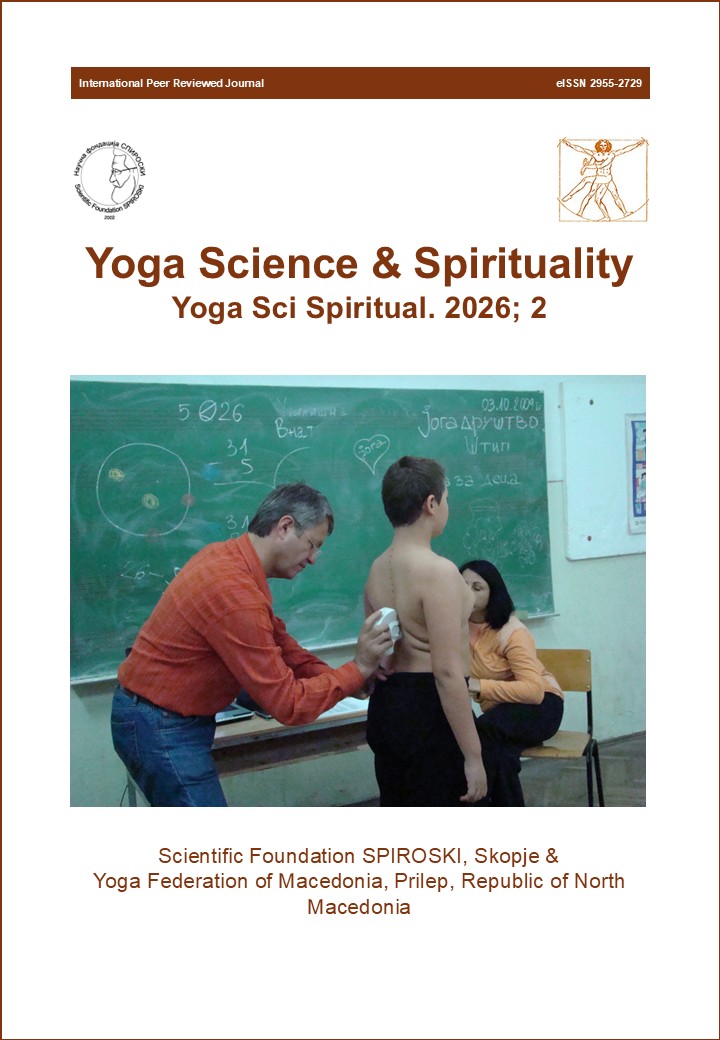
METHODS: A three-month specialized yoga course was conducted within the project “Application of Yoga in Improving the Psychophysical Development of Children in Primary Education.” Thirty-two children aged 7–14 years participated in the initial assessment, while 22 completed the follow-up evaluation. The program included relaxation techniques, Vyayama exercises, Asanas, and Pranayama. Anthropometric measurements, postural assessments, and telemetric spinal evaluations using the Spinal Mouse device were performed before and after the intervention. Parameters assessed included spinal and pelvic mobility, body posture, spinal elasticity, and scoliosis severity.
RESULTS: Initial measurements revealed reduced spinal and pelvic mobility in a substantial proportion of participants, with 68.7% demonstrating incorrect posture and 84.4% showing signs of scoliosis. Following the yoga intervention, significant improvements were observed in spinal mobility and elasticity. The proportion of children with correct body posture increased from 31.3% to 68.2%, while good spinal flexion improved from 43.7% to 59.1% and good spinal extension from 50.0% to 54.5%. Improvements were also observed in thoracic, lumbar, pelvic, and whole-spine mobility. Children with mild scoliosis demonstrated notable improvement, whereas moderate and severe scoliosis showed limited response to the general yoga program.
CONCLUSION: The specialized yoga program significantly improved spinal mobility, elasticity, and body posture in school-age children. Regular practice of yoga techniques contributed to better musculoskeletal function, enhanced flexibility, improved breathing patterns, and positive effects on psychophysical development. Yoga appears to be an effective preventive and supportive therapeutic approach for postural disorders and mild scoliosis in children, although more targeted interventions may be required for moderate and severe spinal deformities.
Downloads
References
1. Hassanagas PK. The basis of teaching methodology of Hatha yoga. Skopje: Skopje Yoga Society; 1982.
2. Hassanagas PK. Guide of techniques of body and mind culture. Skopje: Yoga Society–Skopje; 1985.
3. Gharote ML, Ganguly SK. Teaching method for yogic practices. Lonavla: Kaivalyadhama; 2001.
4. Edrovska K, Stojmenova E, Aleksovska V. Yoga for children at school age. In: Proceedings of the 5th World Congress of Yoga and Holistic Medicine; 1994; Annecy, France.
5. Hassanagas PK. Introduction in Hatha yoga techniques. Skopje: Yoga Society–Skopje. 1985.
Downloads
Published
How to Cite
License
Copyright (c) 2026 Tome Binovski

This work is licensed under a Creative Commons Attribution-NonCommercial 4.0 International License.