The Digital Assistant at the Dental Chair: How Artificial Intelligence Facilitates the Management of Complex Cases
DOI:
https://doi.org/10.3889/mmej.2026.6901Keywords:
artificial intelligence, digital dentistry, navigated implant surgery, digital planning, CBCT, interdisciplinary approachAbstract
INTRODUCTION: The digital transformation of modern dentistry, particularly oral implantology, enables the application of advanced technologies in the diagnosis, planning, and execution of complex clinical procedures. Artificial intelligence, digital planning, and computer-assisted navigated implant surgery are tools that can improve treatment accuracy and predictability. However, their application raises important questions regarding accuracy, system limitations, and the need for appropriate clinical assessment.
AIM: To present the actual clinical potential and limitations of artificial intelligence and navigated implant surgery in the management of complex dental cases, with particular emphasis on their role in supporting clinical decision-making and interdisciplinary treatment planning.
LECTURE CONTENT: The lecture will address the principles of digital planning and navigated implant surgery, as well as the factors influencing the accuracy between the virtually planned and the actual three-dimensional implant position. Particular attention will be given to the quality of CBCT scans, the stability and calibration of navigation systems, and the operator's experience. The limitations of flapless surgical approaches, possible anatomical variations, critical evaluation of digital database information, and the risks of uncritical reliance on software-based solutions will also be discussed. Further topics will include challenges related to the timing of surgical and prosthetic procedures, changes in soft tissues, and individual occlusal and mandibular movements in digital prosthetic planning. The importance of collaboration between the surgeon, prosthodontist, radiologist, and dental technician will also be highlighted.
CONCLUSION: Artificial intelligence and navigated implant surgery can significantly support the planning and execution of complex dental procedures; however, they cannot replace clinical judgment, surgical experience, or an individualized approach to patient care. Predictable treatment outcomes depend on appropriate patient selection, clearly defined indications, awareness of the limitations of digital systems, and coordinated interdisciplinary collaboration. Digital technology should serve as an assistant in clinical practice rather than a substitute for professional decision-making.
Downloads
Author Biography
Filip Tanturovski , Faculty of Dental Medicine, MIT University, Skopje, RN Macedonia; Zan Mitrev Clinical Hospital, Department of Prosthodontics, Skopje, RN Macedonia
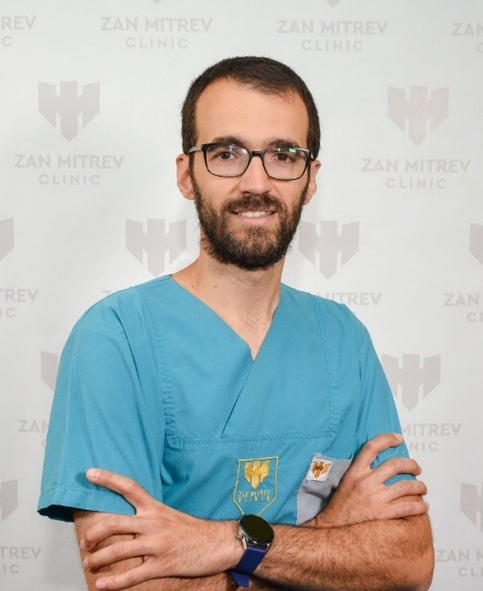
Asst. Prof. Dr. Filip Tanturovski is a Doctor of Dental Sciences and a specialist in dental prosthetics. He graduated from the Faculty of Dentistry at Ss. Cyril and Methodius University in Skopje in 2012. In the academic year 2012/2013, he enrolled in the second cycle of studies at the same faculty, and in 2014 he successfully defended his master’s thesis in the field of dental prosthetics. He then continued with doctoral studies, which he completed in 2022 with a dissertation focused on the assessment of respiratory capacity in users of complete dentures, earning the academic title of Doctor of Dental Sciences. Dr. Tanturovski regularly participates in dental congresses and symposiums and is the author and co-author of multiple scientific papers and publications. He is currently employed as a specialist in dental prosthetics at the “Zan Mitrev” Clinical Hospital and serves as an active faculty member at the Department of Dental Prosthetics at MIT University in Skopje.
Downloads
Published
How to Cite
License
Copyright (c) 2026 Filip Tanturovski

This work is licensed under a Creative Commons Attribution-NonCommercial 4.0 International License.